The easiest mistake is to think Manchester City have always owned the summer.
Now a major tournament arrives and the club seems to scatter across it. City players captain countries, decide knockout ties and return late for pre-season because they have spent June and July carrying national expectations. Supporting them can become an administrative task. You need fixture lists, several screens and a working knowledge of which teammates may soon be kicking lumps out of each other.
It was not always like this.
There was a time when finding a City player at a World Cup or European Championship felt like discovering somebody you knew on television. You had waited through the squad announcement, checked the substitutes and perhaps adopted an entire country because one familiar name was involved. Before tournament guides, wall charts and world cup betting offers took over the summer, the first question for many Blues was simpler: have we actually got anyone going?
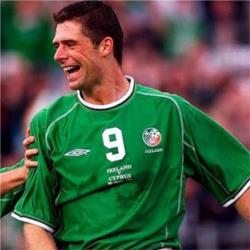
In the 1990s, the answer was rarely generous. Niall Quinn gave City supporters a direct interest in the Republic of Ireland at the 1990 and 1994 World Cups, although injury kept him out of the latter tournament. His presence mattered partly because it was unusual. This was not one representative among a dozen. This was your man, carrying a small piece of Maine Road into a competition otherwise dominated by players from clubs City were trying, often unsuccessfully, to catch.
Euro 96 was staged in England, filled the country with flags and produced weeks of national longing. City’s contribution was largely indirect. Plenty of players involved would later pass through the club, but the City of that moment was heading out of the Premier League. While England argued about Gascoigne, Shearer and whether football was coming home, Blues were confronting a rather different future.
That distance gave every international appearance weight. A cap felt like recognition not only for the player but for the club. The rest of football might have regarded City as erratic, unfashionable or occasionally comic. Then one of ours walked out at a World Cup and, for an afternoon, the shirt seemed connected to the centre of the game.
Nostalgia can make scarcity appear more romantic than it was. Nobody should seriously prefer a squad lacking internationals simply because following tournaments required less concentration. The old excitement came with an uncomfortable truth: City players were rare at major championships because City rarely employed enough footballers of that level.
Still, rarity changed the way supporters watched.
At the 2002 World Cup, City had returned to the Premier League under Kevin Keegan and sent a small but memorable group to Japan and South Korea. Sun Jihai represented China, Lucien Mettomo travelled with Cameroon and Paulo Wanchope led Costa Rica’s attack. Wanchope scored against Brazil in a wild 5-2 defeat, the sort of moment that could sustain a Blue through the rest of the tournament. The BBC’s retrospective on the story of the 2002 World Cup remembers Ronaldo, Brazil and Asia’s first finals. City supporters can attach their own, smaller memories to it.
That was the bargain. The club provided a player or two; the supporter provided unreasonable devotion to their national side. Costa Rica were not merely Costa Rica. They were Wanchope’s Costa Rica. China’s matches required attention because Sun might be playing. Cameroon’s team sheet had to be checked for Mettomo.
Today the experience is reversed. At the 2022 World Cup, City had 16 players representing their countries in Qatar. Sixteen. Enough to fill a starting XI, a bench and several arguments about who should play at left-back. Julián Álvarez returned as a world champion. Rodri, Bernardo Silva, Kevin De Bruyne, Phil Foden, Kyle Walker, John Stones, Ederson and others arrived as central figures rather than curious inclusions.
This abundance has altered expectations. A City player making a tournament squad is no longer news. Being left out is. The club does not hope to be represented at the highest level; it expects to shape it.
Something is gained in that change, obviously. There is pride in watching footballers from your club control the largest matches. Their presence confirms what the trophies already tell us: City now live at the sport’s centre rather than peering towards it.
Something smaller has been lost. Not success, and certainly not quality, but the intimacy of having one player to follow. When half the dressing room travels, international football can feel like an extension of club politics. You worry about injuries, minutes and who will return exhausted. Supporting everyone becomes impossible once they begin eliminating one another.
Back then, a single City name on a squad list could organise an entire summer. You watched unfamiliar teams, learned unfamiliar players and celebrated modest moments because one of ours had been trusted on the world stage.
Now City send the world.
It is better this way. Only nostalgia would argue otherwise. But when another tournament arrives and the squad lists fill with familiar names, it is worth remembering when one was enough.